GEOTECHNICAL ENGINEERING
GARLAND

Geotechnical Engineering in Garland

Evidence-based design. Reliable delivery.

LEARN MORE

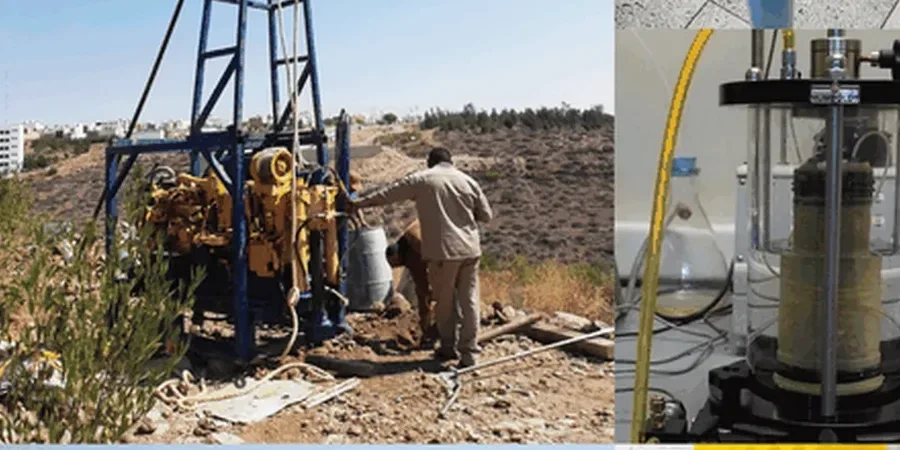
Garland sits on the expansive Blackland Prairie soils, and anyone who has managed earthworks near Lake Ray Hubbard or along the Rowlett Creek floodplain knows the subsurface here doesn't forgive assumptions. A soil mechanics study in this part of Dallas County goes well beyond a simple boring log—it defines the load-deformation response, pore pressure behavior, and shear strength envelope that will govern your foundation design. Because the city's eastern zones transition from stiff residual clays into looser alluvial deposits, the interaction between footing geometry and soil stiffness often dictates whether a project needs ground improvement or can proceed with a conventional shallow system. When we run a full program of triaxial and consolidation testing on Shelby tube samples recovered from depths of 10 to 30 feet, the resulting parameters let the structural engineer size footings with confidence instead of guessing at presumptive values lifted from a generic table. Before mobilizing the drill rig, many contractors supplement the laboratory phase with an SPT drilling campaign to correlate blow counts against undisturbed strength, especially where the stratigraphy includes interbedded sand lenses that can mask a weak layer just below the planned bearing elevation.

Expansive clay in Garland can exert swell pressures above 5,000 psf. A proper soil mechanics study catches that before the slab is poured.
Geotechnical Engineering in Garland
Technical reference — Garland

Our service areas

Local geology

With a population exceeding 240,000 and a building stock that mixes 1970s slab-on-grade homes with new tilt-wall distribution centers near the President George Bush Turnpike, Garland's geotechnical demands cover a wide spectrum. A soil mechanics study in this environment must characterize not just the bulk unit weight and moisture content, but the effective stress parameters—friction angle and cohesion—that control how the soil mass behaves under drained and undrained loading. Our laboratory runs consolidated-undrained (CU) and consolidated-drained (CD) triaxial series on specimens trimmed from thin-wall tubes, producing Mohr-Coulomb envelopes that tie directly into slope stability and retaining wall calculations. For projects where groundwater is perched within the upper 15 feet, we pair strength testing with one-dimensional consolidation to generate the compression index and preconsolidation pressure, which feed settlement predictions under the actual structural load. Teams working on roadway subgrades often combine this with a CBR test on site to verify that the compacted fill will support heavy truck traffic without rutting during Garland's hot, dry summers. The data package we deliver includes Atterberg limits, grain size distribution, and direct shear on remolded specimens so the civil designer sees both the intact and disturbed behavior of the formation.

Reference standards

IBC 2021 (Chapter 18 – Soils and Foundations), ASCE 7-22 (Minimum Design Loads and Associated Criteria for Buildings), ASTM D4767 (Consolidated Undrained Triaxial Compression Test), ASTM D2435 (One-Dimensional Consolidation Properties of Soils), ASTM D4546 (One-Dimensional Swell or Collapse of Soils)

Need a geotechnical assessment?

Reply within 24h.

Email: [email protected]

Why choose us

The International Building Code (IBC) and ASCE 7-22 require a site-specific geotechnical report for any structure classified as Risk Category II or higher, and in Garland that covers virtually every commercial building permit. The danger isn't just a code violation—it's differential heave. The Eagle Ford Shale and Austin Chalk weathered into fat clays that can lift a lightly loaded slab edge by two inches between a wet spring and a dry August, cracking partition walls and binding doors. If the soil mechanics study skips swell-consolidation testing or fails to report the suction profile, the structural engineer has no basis to specify the required underslab moisture barrier or to size the stiffening beams correctly. Deep excavations near the White Rock Creek basin face an additional hazard: temporary loss of suction during rain events can reduce the apparent cohesion of near-surface clays by 40% or more, triggering sloughing in open cuts. We document these seasonal sensitivity curves so the contractor can plan dewatering and shoring before the first bucket breaks ground.

Technical data

ParameterTypical value
Effective friction angle (CD triaxial)22° – 34° (varies with plasticity index)
Undrained shear strength (CU triaxial)800 – 2,400 psf for stiff clays
Compression index (Cc)0.18 – 0.35 in upper fat clays
Preconsolidation pressure1.5 – 3.8 tsf, depth-dependent
Swell potential (ASTM D4546)Moderate to very high (>4% volumetric)
Saturated unit weight118 – 128 pcf
Permeability (falling head)1×10⁻⁶ to 1×10⁻⁸ cm/s

Frequently asked questions

How much does a soil mechanics study cost for a commercial lot in Garland?

For a typical commercial lot in Garland requiring two borings, Shelby tube sampling, and a full laboratory suite—triaxial, consolidation, swell, and index testing—the soil mechanics study generally ranges from US$2,840 to US$5,800. The final cost depends on boring depth, number of samples tested, and whether groundwater monitoring wells are required by the city's drainage criteria.

Does Garland have expansive soil, and how does that affect my foundation design?

Yes, large portions of Garland are underlain by the Taylor Marl and Eagle Ford formations, which weather into highly plastic clays with liquid limits often exceeding 50. A soil mechanics study measures the swell pressure and volume change potential so the structural engineer can design a stiffened slab or pier-and-beam system with the appropriate beam depth and reinforcement to resist differential movement.

What laboratory tests are included in a standard soil mechanics study for a Garland project?

A standard program includes moisture content, unit weight, Atterberg limits, grain size distribution with hydrometer, unconfined compression on selected samples, one-dimensional consolidation, and consolidated-undrained triaxial shear. If the site is within a FEMA flood zone or near creek alluvium, we add permeability testing and double-ring infiltration to support drainage design.

How long does it take to get the final geotechnical report after drilling in Garland?

Drilling and sampling typically take one to two days on site. The laboratory phase—particularly consolidation and triaxial tests that require multi-day saturation and shear stages—runs 10 to 14 business days. The final report, signed by a Texas-licensed professional engineer, is delivered within three weeks of field completion for most medium-complexity projects.

Location and service area

We serve projects in Garland and surrounding areas.

View larger map