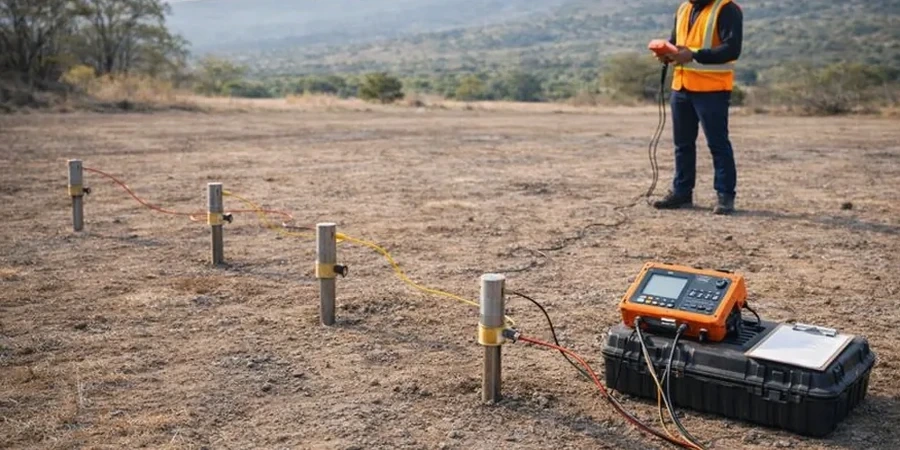
Garland sits at roughly 550 feet elevation on the Blackland Prairie, where the Eagle Ford Shale and Austin Chalk create sharp resistivity contrasts that aren't always obvious from the surface. We run VES surveys here weekly, mapping the contact between expansive clay and weathered limestone before excavation starts. With a population exceeding 240,000, the city has seen steady commercial growth along I-635 and the Bush Turnpike, and nearly every new pad site benefits from knowing what's underground before the first backhoe arrives. The clay-shale interface in Garland can vary by 10 feet across a single lot, and guessing wrong leads to costly surprises. Our field crew sets up the 4-electrode array, runs the Schlumberger configuration, and delivers a layered resistivity model the same week. The data often reveals perched water within the Taylor Marl that standard borings miss entirely, which is why combining resistivity with a CPT test gives you a much tighter picture of the subsurface profile.
A resistivity profile across Garland's Blackland Prairie clay can identify a 2-foot sand lens at 20 feet depth that completely changes your foundation design.